
Listing scope
KLOW 80 mg is documented as TB-500 10 mg, BPC-157 10 mg, GHK-Cu 50 mg and KPV 10 mg for batch WM-N4Y8-Klow80.
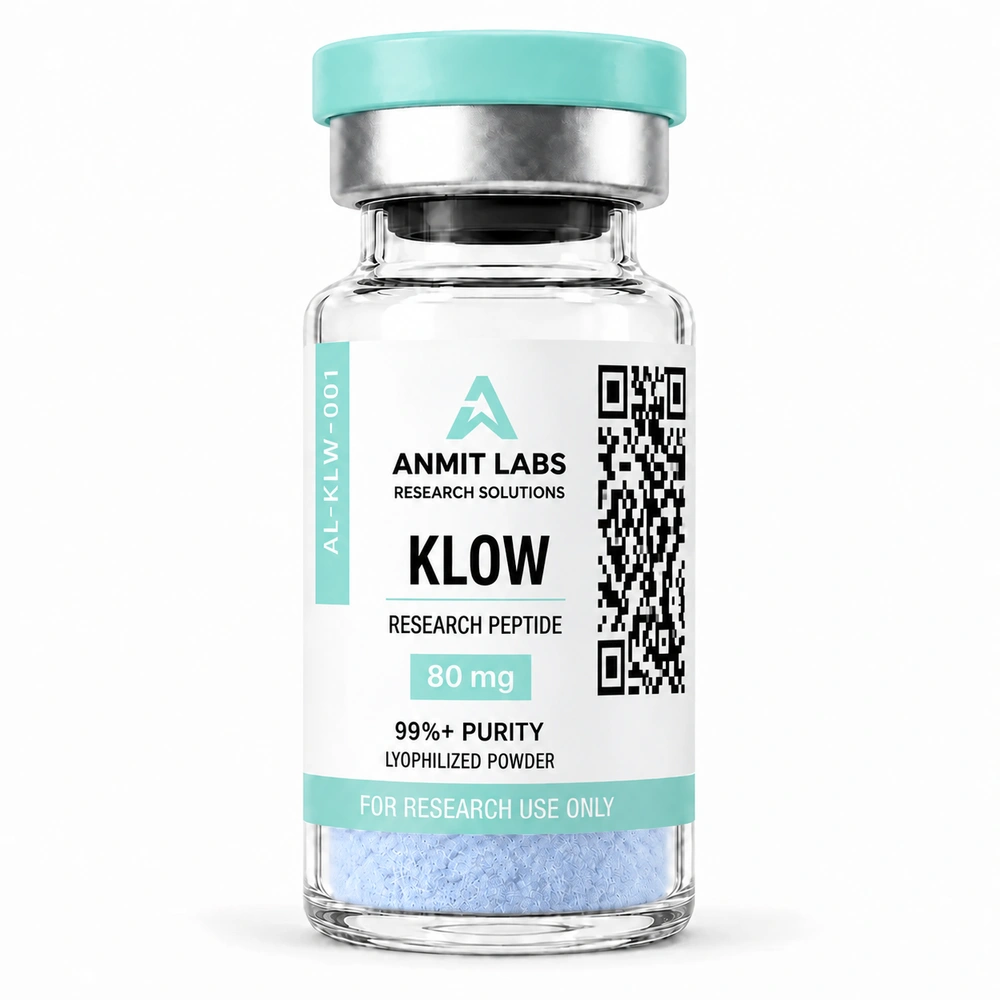 NEWKLOW
KLOW research material with the available vial strength, stock status and batch-linked documentation shown before ordering. For laboratory research only; not for human or veterinary use.
Support for buyer questions, bulk requests and distributor inquiries.
From the linked COA PDF. Applies only to the linked batch.
View batch COAView batch COA
EU shipping €7.30 · Balkans/Switzerland €8.50 · Ukraine €12.90 · free for orders over €200
Four-component laboratory research blend. This record separates catalogue facts from batch-specific analytical evidence.
Quality owner: ANMIT Labs Quality and Documentation · Editorial reviewer: ANMIT Labs Scientific Content Review
KLOW 80 mg is documented as TB-500 10 mg, BPC-157 10 mg, GHK-Cu 50 mg and KPV 10 mg for batch WM-N4Y8-Klow80.
Match all four component strengths, batch and report date to the linked COA.
Use the verified label and batch documentation for laboratory handling.
1 variant document across 1 batch record. Open the HTML record first, then compare it with the original PDF.
RP-HPLC reports chromatographic purity under the certificate’s stated conditions. ESI-MS or LC-MS information can support molecular identity. These are separate questions, so the record preserves both fields.
The listed results do not alone prove sterility, endotoxin status, exact fill quantity, long-term stability, suitability for a protocol, or safety for human or animal use.
No. A certificate applies only to the product, variant and batch that can be matched to that document. The page keeps every available PDF beside its exact listed variant.
It reports chromatographic purity under the method and detection conditions stated in that certificate. It does not by itself prove identity, sterility, fill quantity, suitability for a purpose or freedom from every possible contaminant.
Mass-spectrometry information can support molecular identity. It answers a different question from chromatographic purity, so both method and interpretation limits are shown separately.